
towards a different relationship with the ocean
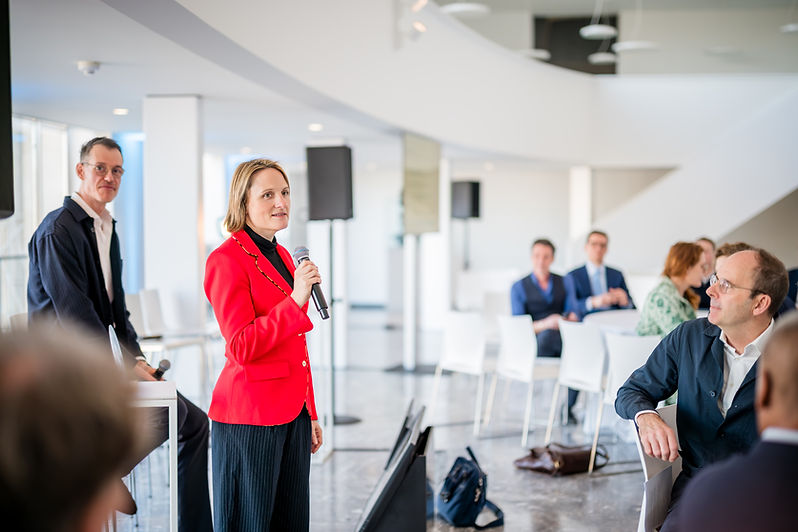
The second edition of the Funders Forum at EU Ocean Days in Brussels took place at a moment of growing clarity.
The ocean is under pressure at the level of the system.
Marine ecosystems are degrading. Biodiversity is declining. The capacity of the ocean to regulate climate, sustain food systems, and stabilise the conditions on which economies depend is being steadily weakened. These are not isolated signals. They point to stress within the largest living system on the planet.
For a long time, this reality has been acknowledged in principle, but addressed in fragments.
Projects. Programmes. Isolated initiatives.
What is missing is an approach that matches the structure of the system itself.
The Forum was convened around that gap.The discussions spanned the core domains through which this system is now being reshaped, from ocean observation and biodiversity to emerging bioeconomies, critical materials, and the transition of shipping, trade, and offshore energy.
Not simply to increase activity, but to ask a more difficult question.
What does it mean to act in a way that is adequate to the ocean?

why this moment matters
The conditions shaping ocean action are changing.
Public funding is under pressure. Multilateral alignment is less stable. Institutions across philanthropy, policy, and investment remain structured around mandates that were not designed for challenges of this nature.
At the same time, the underlying risk has shifted.
Ocean degradation is no longer a distant concern. It is already affecting supply chains, coastal economies, insurance exposure, and long term stability. The value at risk does not sit in any single sector. It sits in the continued functioning of the system itself.
The ocean does not only support economic activity. It underpins it. Its health is not one variable among others, but the condition on which long term value depends.
This creates a different kind of imperative.
Not more effort in the same form.
A different way of organising that effort.

the ocean as shared system
A clearer framing emerged through the Forum.
The ocean is not only something to protect. It is shared infrastructure.
It regulates climate, supports biodiversity, enables trade and energy systems, and sustains livelihoods across regions. When it weakens, the consequences move across systems that were never designed to absorb that level of disruption.
Understanding the ocean in this way changes what action requires.
It expands responsibility beyond environmental actors. It also raises the standard. Actions must work across boundaries, hold ecological integrity at the centre, and recognise the interdependence between natural systems and economic stability.

the system is not failing from lack of effort
The primary barriers are not scientific.
Knowledge is advancing. Innovation is emerging.
The breakdown lies in how these elements connect.
Efforts remain fragmented across institutions and stages. Critical functions such as biodiversity protection, ecosystem monitoring, and long term resilience remain undervalued because they do not fit existing models. Opportunities fail to move from one stage to another, not for lack of intent, but for lack of alignment.
In many cases, the issue is not the absence of capital, but the absence of the conditions that allow it to engage in ways that are effective, timely, and appropriate to the system.
This creates a system with activity, but without pathways.
And without pathways, progress does not scale.

What the ocean demands
Responding to the ocean on its own terms requires a shift in how action is understood.
It means moving beyond isolated interventions towards approaches that work at the level of systems. Ecological health, infrastructure, markets, and governance must be considered together, over time.
It also requires discipline.
This is a question of sequence. Infrastructure before scale. Demand before deployment. Conditions before capital. Without this discipline, even well intended efforts arrive too early, too late, or in the wrong form.
Responding effectively also requires recognising that capital is not a single instrument. Different forms of capital play different roles across a pathway, from early ecosystem support to market shaping to scaled deployment. These roles depend on alignment, timing, and clarity of purpose.
Not everything should be treated as an investment opportunity.
Some parts of the ocean system must remain outside market logic. Biodiversity, climate regulation, and ecosystem stability are collective goods. Treating them as financial instruments risks distorting the very systems they are meant to sustain.
Other areas require public architecture. Some may become investable, but only when the conditions that sustain them are in place.
Clarity on these distinctions is essential.
Without it, efforts either distort the system or leave critical functions unsupported.

A shift in how actors see their role
The Forum did not produce a single solution.
It shifted how the system is understood.
Participants gained a clearer view of the limits of their current approaches, and of the dependencies between them. When institutions are exposed to how others operate across different mandates and constraints, their field of vision expands.
New forms of coordination become possible.
Over time, this reduces the friction that has limited collaboration. It allows alignment to move from principle to practice.
In a system of this complexity, that shift is not secondary.
It is foundational.
looking ahead
The next phase focuses on application.
Future editions will test how coordination can be made operational. This includes shared intelligence, stronger demand conditions, and place based approaches that reflect how ocean systems function in reality.
The objective is not to define a single model.
It is to create the conditions in which multiple approaches can emerge, each aligned with the system it serves.
The question is no longer whether the ocean matters.
It is whether institutions can adapt with enough clarity and speed to operate in ways that protect and sustain it.
